
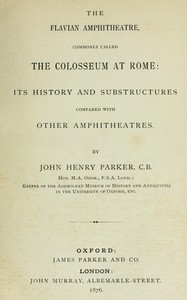
The archæology of Rome, Part 7 : The Flavian amphitheatre, commonly called the…
John Henry Parker’s dive into the Colosseum is like getting a tour from someone who has spent his entire life staring at ancient stones and piecing together their secrets. It’s not a slow, dusty textbook but a detective story about a building that refuses to give up all its secrets.
The Story
So what’s actually going on in this book? Parker walks you through the building, from the arena floor up to the highest seats, explaining how 50,000 (or more) people managed to get in, find their seats, cheer, and not spill too many tears when lions or gladiators stole the show. He’s obsessed with how they kept order, used ropes and pulleys to lift sets and animals, and even handled ticket stubs—yes, they had them way back when. The big plot here is a real building that was a miracle of engineering: started under Emperor Vespasian, finished under his son Titus, and then cursed over centuries. Parker digs into the lore, the actual history, and the rumors about who wrecked the marble facing, what Victorian tourists wrote on the walls, and when it started being used as a medieval fortress by Roman barons. It’s part ancient mystery, part vandalism narrative, part urban planning lesson.
Why You Should Read It
Honestly? Because the Colosseum today is just a giant shell of its old self. You stare at it and think, ‘Wow, huge!’ but are blind to the 90% of the story buried in its foundation. Parker lights up the bits we can’t see—drains, trap doors, stables for lions. He makes you feel like you’ve snuck into a back area no tourist gets near. Plus, his writing isn’t a dry drone; he sounds more like a very excited historian who has measured every brick. You’ll start noticing modern arenas owe giant debts to the Romans. Parker’s big thought is that the building has been a victim of its fame, partly because 2,000 years of myth mucked it up after the real blueprint faded. Yet it still stands because it’s too massive to knock down.
Final Verdict
This one is for the traveler who craves the ‘why’ behind the souvenir. If you’re a history buff who hates textbooks, or you google ‘amphitheatre mechanism’ in your free time—this is your jam. Casual readers, don’t worry; Parker writes in full sentences without dusty language, but he doesn’t coddle you with fluff. This book will leave you proddy to get back to tater-tots and read Roman engineering books. Stands really well alone even though it’s part of a series—it’s a full tour.
This is a copyright-free edition. Distribute this work to help spread literacy.
Jessica Johnson
6 months agoGreat value and very well written.
George Martinez
5 months agoHaving explored several resources on this, I find that the attention to detail regarding the core terminology is flawless. Finally, a source that prioritizes accuracy over hype.
Robert Smith
2 weeks agoGiven the current trends in this field, the author doesn't just scratch the surface but goes into meaningful detail. A mandatory read for anyone in this industry.
Susan Miller
11 months agoThe research depth is palpable from the very first chapter.








Paul Thompson
7 months agoUnlike many other resources I've purchased before, the step-by-step breakdown of the methodology is extremely helpful for students. I'm glad I chose this over the other alternatives.