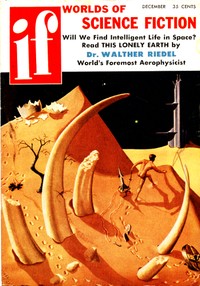
A Little Knowledge — A Closer Reading
Edition facts
The story opens with a striking comparison: Olbu's arrival on Earth is deemed a greater triumph than anything Caesar staged. This sets the tone for a narrative that juxtaposes human self-importance with alien condescension. Olbu, who learned English overnight, dismisses Earth as a 'barbaric planet,' yet he is the one who ultimately loses his home world. The tension between human and alien viewpoints drives the plot, with the television interview serving as a stage for cultural and intellectual clashes.
The Television Interview as a Stage for Conflict
The story unfolds primarily through a live television interview, a setting that amplifies the contrast between public performance and private stakes. Ralph Rodkey of the Interstate Broadcasting Network orchestrates the event, treating Olbu as a spectacle. The alien's discomfort with Earth's 'hero worshippers' and 'barbaric' celebrations is clear. Cecil Burroughs, the commentator, and Dr. Alymir Bruber, the scientist, represent Earth's attempt to appear knowledgeable. However, Olbu's mental powers and his condescension toward human science create an undercurrent of tension. The interview format allows Winterbotham to reveal information gradually, with the sponsor break and the final sign-off underscoring the triviality of television against cosmic events.
Knowledge as a Double-Edged Sword
The title 'A Little Knowledge' is ironic. Olbu possesses advanced knowledge of space flight and mental powers, yet he is ignorant of his own planet's destruction. Dr. Bruber, who has studied GC1242 for years, knows it became a supernova fifteen years ago. The story suggests that knowledge can be dangerous: Earth's atomic fire and Olbu's home star's instability are both results of technological progress. The final exchange between Rodkey and Bruber implies that another civilization destroyed GC1242, just as Olbu's people intended to do to Earth. This cyclical pattern of destruction based on knowledge and power is the story's central warning.
Contrasting Voices: Human and Alien Perspectives
Winterbotham uses dialogue to highlight the differences between human and alien thought. Olbu speaks in a formal, almost clinical manner, referring to Earth as 'barbaric' and humans as 'stupid.' In contrast, Rodkey and Burroughs use colloquial, promotional language, treating the interview as entertainment. Dr. Bruber's polite, roundabout method of stating facts contrasts with Olbu's bluntness. The story's climax occurs when Olbu, using his mental powers, realizes his world is gone. His shift from arrogance to vulnerability is subtle but effective. The final lines, with Bruber's ominous suggestion that 'somebody else was just a little more advanced,' leave the reader with a chilling sense of cosmic irony.
Readers should pay attention to the story's structure: the television interview is not just a backdrop but a mechanism for revealing character and conflict. The sponsor break and the trivial mention of rattlesnake tamers and cobra stuffers underscore the banality of Earth's concerns. The story's brevity (about 6,400 words) allows for a tight, focused narrative. Consider how Winterbotham uses the alien's perspective to critique human arrogance, while simultaneously showing that the alien's own civilization was equally flawed.