Arcturus Times Three — Key Ideas to Explore
Edition facts
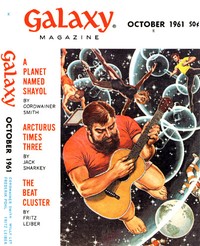
Jack Sharkey's Arcturus Times Three opens not with narrative but with a fictional textbook excerpt titled 'ZOOLOGY 2097,' which recounts the disastrous second Mars landing and the discovery of the 'quilties'—furry, cuddly creatures that turned out to be parasitic, killing the crew by gestating grubs inside them. This framing device immediately establishes the story's central concern: the lethal unpredictability of alien life-forms and the need for a specialized 'Space Zoologist' to mediate contact. The catalog subjects list 'Human-alien encounters' and 'Life on other planets,' but the excerpts show that the story is less about generic encounters and more about the specific, embodied risks of interspecies communication.
The Textbook as Narrative Frame
The opening pages of the novella are not a conventional story but a lecture excerpt from a manual titled 'CONTACT—Its Application and Indigenous Hazards' by Lt. Commander Lloyd Rayburn. This fictional academic text recounts the 'disastrous second Mars landing' in detail, describing how the 'quilties'—beasts 'somewhere between marmosets and koalas' with 'bright orange and green tangles of fur'—were adopted as pets before killing the crew. The passage is written in a dry, expository tone, complete with a footnote-like explanation of the term 'quilties.' This technique grounds the science fiction premise in a pseudo-documentary style, lending weight to the dangers that protagonist Jerry Norcriss will face. The catalog subject 'Science fiction' is accurate, but the excerpts reveal a specific subgenre: the 'hard' SF story that uses technical exposition to build credibility.
Contact as Bodily Disorientation
Norcriss's experience of 'Contact' is portrayed as a jarring, sensory dislocation. When he awakens in an alien body, his perception is fragmented: 'His vista was oddly diverted into vertical panels' before he realizes these are bars. He then assesses his own form, noting 'hard gray scales over a curving belly' and hind feet 'all phalanges and no metatarsals.' The narrative emphasizes his struggle to reconcile his human consciousness with a non-human anatomy. The catalog subject 'Life on other planets' is present, but the excerpts focus less on the planets themselves and more on the subjective, embodied experience of being alien. Norcriss's internal monologue—speculating about the origin of bars or the nature of the creatures' furred palms—reveals a mind trying to impose human logic on utterly foreign biology.
Intelligence as a Barrier to Knowledge
A recurring constraint in the excerpts is that Contact cannot be made with intelligent minds: 'Intelligence equated with impenetrability, so far as Contact went.' This rule forces Norcriss to rely on observation and inference rather than direct mental access. When he encounters the white-furred, double-jointed beings, he can only guess at their culture from their 'satiny uniforms' and the behavior of a 'man of apparently lesser rank' working on a machine. The catalog subject 'Human-alien encounters' is thus complicated by the story's own logic: true understanding is impossible. The excerpts do not show a resolution to this problem, leaving the reader to wonder how Norcriss can fulfill his role as a Space Zoologist when the most important subjects remain opaque.
The excerpts from Arcturus Times Three offer a focused look at a mid-century SF story that prioritizes procedural detail and psychological dislocation over action. Readers should note that the complete text likely contains additional Contacts and further development of the 'Contact' technology's limitations. The story's brevity (under 17,000 words) suggests a tight narrative, and the excerpts hint at a structure alternating between Norcriss's alien experiences and the human technicians monitoring his life-pulse. Pay attention to how Sharkey balances the textbook frame with the subjective, often bewildering, first-person accounts of inhabiting other bodies.