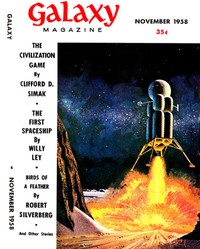

Peace — Context and Discussion
Edition facts
Arkawy and Henig's 'Peace' is a short story told almost entirely through official documents: peace communiqués, a Bureau of Public Information report, and a list of citizen duties. The narrative voice is that of the Venusian occupiers, who have renamed Earth 'Rios' and Venus 'Nwad' for the conquered population's understanding. The opening line—'We bid you welcome, Earthmen! Take your rightful place beside us, share our peaceful existence'—immediately establishes the ironic gap between the invaders' rhetoric and the reality of their rule.
The Bureaucratic Voice of Conquest
The story's structure mimics official propaganda. The first document, 'Peace Communique No. 1,' announces the war's end and the exile of Earth's leaders. The second, a 'Report to the People of Rios,' provides a sanitized history of the conflict, using Riosic terminology to 'provide for full understanding.' The report describes Venusian space scientists observing Earth for centuries, noting that 'the most obvious fact we learned was that its dominant race was aggressive and war-like.' This framing justifies the invasion as a preemptive pacification.
The language is clinical and euphemistic. The Venusian fleet 'completely obliterated' the Earth fleet; the occupation is described as 'assistance.' The report even notes an 'interesting coincidence' that atomic power was discovered on Earth just as Venus made it obsolete—a detail that underscores the technological disparity and the condescending tone of the conquerors.
The Five General Duties: A Dystopian Contract
The most striking section is the list of 'GENERAL DUTIES OF A CITIZEN' appended to the second communiqué. These duties include working one-third of each day, maintaining sleeping areas per barracks directives, and—for every citizen—fathering or bearing a child 'once every alternate cycle.' The fifth duty requires citizens to 'report to [their] extermination center immediately upon notification.' A note explains that 'periodic exterminations must be held among the general citizenry' to prevent overpopulation, targeting the incurably sick, insane, feeble-minded, disabled, dishonest, aged, and randomly selected others.
The chilling detail is the warning that failure to report promptly results in 'a delayed and painful process.' This bureaucratic cruelty, presented as a matter-of-fact regulation, transforms the promised peace into a system of total control. The story does not show any resistance or dissent; the documents stand alone, implying a population that has no choice but to comply.
The Irony of the Title
The title 'Peace' is the story's central irony. Every document uses the word repeatedly: 'Peace has been restored to the system,' 'you shall have peace,' 'peace and security have been attained.' Yet the peace is enforced by military occupation, exile of leaders, and systematic extermination. The Venusians claim to welcome Earthmen as equals, but the duties reveal a rigid hierarchy where compliance is mandatory and dissent is eliminated.
The story never shows a Venusian character or an Earthling's perspective. The entire narrative is filtered through propaganda, leaving the reader to infer the horror behind the official language. This technique makes the story more unsettling than a direct depiction of violence might be, as the reader must piece together the reality from the euphemisms. The excerpts end before any Earthling response is given, leaving the occupation's full impact to the imagination.
Readers should pay close attention to the dates and document types: the story moves from a communiqué to a report to a list of duties, each escalating the scope of control. The absence of any Earthling voice is itself a statement—the conquered are not allowed to speak. The story's brevity (under 7,000 words) and its reliance on bureaucratic language make it a sharp, efficient satire of how power justifies itself through officialese.