
Project Hi-Psi — Context and Discussion
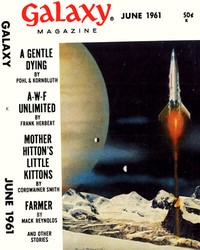
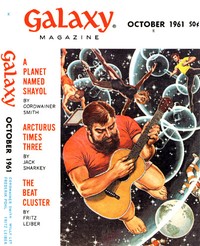
Edition facts
Frank Riley opens Project Hi-Psi with a scene of bureaucratic friction: Dr. Lucifer Brill, a parapsychologist, arrives late to the FBI director's office and insists on reporting a multiple kidnapping. The director's knee hits a button to flip on a tape recorder—a detail that roots the story in mid-1950s institutional procedure. Riley's prose is economical, favoring precise gestures over exposition: Brill rubs his mustache knuckles, a habit known to graduate students as a sign of annoyance. The secretary's painted lips and plucked eyebrows signal social performance. These small choices establish a world where authority is negotiated through ritual and where the extraordinary—alien abduction—enters through the ordinary channels of law enforcement.
Diction and the Texture of Authority
Riley's word choices consistently reinforce a tone of institutional formality. Brill's speech carries a Chelmsford, Mass. twang, but his syntax is stiff: 'I am aware of that... but the other drivers were not, and there were an incredible number of them on the road.' The director's 'large hands hit the desk top with a cracking sound'—a physical punctuation to bureaucratic frustration. The secretary 'flounced' and 'unpursed her lips,' verbs that convey disapproval without melodrama. Even the aliens adopt this register: Huth speaks of 'orbits beyond the outermost probings of science on Earth' and 'the terrible drag of orthodoxy.' The dialogue never slips into colloquial ease; every character is performing a role within a hierarchy.
Voice as Characterization
Each character's voice is distinct and tied to their function. Brill is peremptory and pedantic, using phrases like 'I must report a most serious case' and 'the purpose of my visit involves a matter of extreme urgency.' The director responds with clipped questions: 'When?—Where?—Who?' Nina Brill, introduced later, speaks with intuitive leaps: 'So we are your nursery!' she exclaims, reducing Huth's millennia-spanning explanation to a single metaphor. Huth himself uses measured, almost academic cadences: 'What society—or our bodies—neglect will eventually die.' Riley avoids marking the alien as other through exotic speech; instead, Huth's voice is calm and analytical, making his otherness a matter of perspective rather than language.
Structure and the Slow Reveal
The narrative unfolds through a series of constrained scenes: Brill's office visit, the nursery test with a crawling child, Huth's exposition. Riley withholds the alien nature of the kidnappers until midway through the excerpt, when Huth reveals his home planet is in the Capella system. The structure mirrors a scientific experiment—hypothesis, test, conclusion—but the stakes are personal. The child's tears and Nina's cooing ground the abstract discussion of psi evolution in physical, emotional detail. Riley uses the nursery test to dramatize the conflict between deterministic science and human unpredictability: Brill moves a bottle, the child crawls, but the outcome is not clean. The structure thus enacts the theme of neglected potential.
Recurring Details and Thematic Resonance
Several details recur with thematic weight. The tape recorder, activated by the director's knee, signals surveillance and documentation—a motif that extends to the aliens' 'experiment under laboratory conditions.' Brill's rimless spectacles and cold blue eyes suggest a man who sees but is not seen. The child's 'red button of a nose' and 'two big tears' are the only moments of unguarded emotion, contrasting with the adults' controlled performances. Huth's reference to Daniel Dunglas Home, a historical medium, anchors the psi concept in real-world lore. These details are not decorative; they build a consistent world where the paranormal is treated as a scientific variable, subject to the same bureaucratic and emotional pressures as any human endeavor.
Readers attentive to Riley's craft will note how he uses the conventions of mid-century procedural fiction—tape recorders, locked doors, strained politeness—to frame a speculative premise. The aliens are not monsters but scientists, and the humans are not victims but subjects. The tension lies not in action but in the gap between what characters say and what their voices reveal. Pay attention to who controls the language: Brill's formal complaints, Huth's measured explanations, Nina's sudden insights. The story's power comes from these verbal negotiations, not from the psi powers themselves.