Short Snorter — Context and Discussion
Edition facts
The story opens with a precise geography: three paths lead from a resort hotel, two clearly marked for lake and golf links, the third unmarked and favored by lovers. Fred and Alice Daniels follow that third path into dense woods, where they find a clearing with a bright red flying saucer. The narrator describes the vehicle in careful detail—three rings, plastic construction, small windows—and Alice immediately identifies it as a flying saucer. Fred’s response is notably understated: he peers inside and reports seeing a steering wheel and dials. The tone is matter-of-fact, blending the extraordinary with the ordinary.
A Saucer with a Steering Wheel
The saucer’s interior is described as having a steering wheel and dials, a detail that deflates the alien mystique. Fred’s hollow report to Alice—“You won’t believe it”—underscores the story’s comic tension. The vehicle is painted gaudy red, a color choice that feels more carnival than cosmic. The narrator avoids any explanation of how the saucer works or where it came from; the focus stays on the couple’s uncertain reactions. They look “almost guilty” as they decide to tell someone. This scene establishes a pattern: the extraordinary is met with mundane responses, and the narrative withholds any alien perspective.
The Hotel as a Stage for Bureaucracy
The resort hotel setting suggests a temporary, liminal space where normal rules might bend. The catalog subject Hotels -- Fiction is apt: the hotel functions as a backdrop for the couple’s attempt to report their discovery. The story’s title, Short Snorter, hints at a drinking tradition among pilots, which may color the tone. Based on the excerpts, the narrative seems to treat the saucer as an object of curiosity rather than threat. The couple’s dialogue is clipped and realistic, with Alice clutching Fred’s arm and Fred repeating “I don’t know.” The hotel likely becomes a stage for bureaucratic or social comedy, though the excerpts do not reveal the resolution.
Voice and Structure: Understatement and Precision
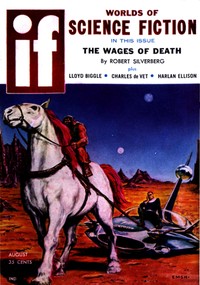
Charles Einstein’s prose is economical and visual. The forest is described with specific details: “the great and near-great trees,” a “silent brook,” a “dismal barrage of thicket.” The saucer’s dimensions are given in yards, not feet, lending a technical air. The dialogue is sparse and naturalistic, with Alice’s laughter undercutting her fear. The story appeared in Worlds of If Science Fiction in 1958, a period when flying saucers were a cultural phenomenon. Yet the narrative resists sensationalism; the saucer is “empty” and “painted a gaudy red.” The structure alternates between descriptive passages and terse exchanges, creating a rhythm that balances wonder with skepticism.
Readers should pay attention to the story’s title and its possible connection to aviation slang, as well as the way the hotel setting frames the encounter. The excerpts suggest a tale more interested in human reactions than alien technology. Note how the narrative withholds the saucer’s origin and purpose, leaving the couple—and the reader—in a state of unresolved curiosity.