The Drivers — Edition Insights
Edition facts
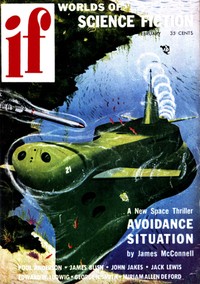
Edward W. Ludwig's 1956 story opens not with a spaceship but with a man climbing concrete steps toward a government office. The DEPARTMENT OF LAND-JET VEHICLES DIVISION OF LICENSES is a bureaucratic labyrinth of robots, analyzers, and technicians—yet the final examiner is human, a detail the story underlines. The protagonist, Tom Rogers, hopes to fail his driving test, a wish that immediately signals that this is no ordinary licensing process. The catalog subjects list 'Transportation -- Fiction' and 'Youth and death -- Fiction,' but the excerpts show a more specific preoccupation: the psychological ordeal of a young man forced to prove his worth through lethal speed.
The Human Touch in a Machine World
The story's setting is saturated with technology: robot-receptionists, silver-boxed analyzers, and a 'quartzite floor' with arrow-shaped lights. Yet the final examiner, Harry Hayden, boasts that his job 'requires the human touch.' This tension between automation and human judgment runs through the excerpts. Hayden's desk placard reads 'Final Examiner—Human,' and his appearance—paunchy, bald, with 'dreamy' contact lenses—contrasts with the sterile office. The story uses this contrast to suggest that the most dangerous decisions are still made by people, not machines. Tom's file is reviewed by a man who wears 'Driver's Ribbons' and 'bronze accident stars' indicating limb replacements, hinting at the physical cost of the system he represents.
Speed as a Test of Character
The driving test itself is a high-speed ordeal on a 'Jetway,' where cars reach six hundred miles per hour and collisions are lethal. Tom's internal monologue reveals his terror: he wipes perspiration, his stomach heaves, and he fights memories of 'screaming flame and black death.' The story measures his progress in numbers—'Five hundred now. Six hundred'—and in time: 'Only ten minutes more.' The threat comes not just from speed but from other drivers, like the 'side-swiper' who forces Tom to use his jets defensively. Ludwig describes the physics of near-misses with precision: the 'torrent of air' from a passing car can hurl a vehicle into the bank. The test is a gauntlet of fear, memory, and mechanical skill.
A Society Built on Risk
The catalog subject 'United States -- Fiction' is borne out by the story's setting: a future America where driving is mandatory and deadly. The opening line declares that 'Jetways were excellent substitutes for war,' framing transportation as a social safety valve. The examiner's ribbons and 'accident stars' suggest a culture that rewards survival. Tom's age—twenty, just under the legal limit—adds urgency: he must get licensed before turning twenty-one. The story's world is one where the 'unfit were weeded out by death,' and the driving test is a rite of passage that could kill. Ludwig does not explain how this system arose; he simply presents it as a given, focusing on Tom's desperate hope to fail and his grudging courage when he must succeed.
Readers should attend to the story's use of sensory detail—the echo of footfalls, the roar of jets, the 'white asphalt like opaque mist'—to ground its speculative premise in visceral experience. The excerpts leave unresolved whether Tom will survive his first day as a licensed driver, but the story's power lies in its claustrophobic focus on the test itself. Ludwig's prose is lean, driven by action and internal conflict, and rewards attention to the small gestures—a handkerchief, a foot on the accelerator—that reveal character under pressure.