Always a Qurono — Themes and Context
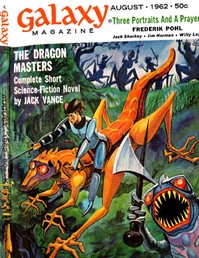
Edition facts
From its first line—'You too can be a Qurono'—Jim Harmon's story signals a sardonic take on command and conformity. The opening scene places Captain Barnhart aboard a ship where the crew, led by the pale, blue-veined Simmons, threatens mutiny rather than phase into a sun. Barnhart's internal refrain, 'Officers must never panic,' sets up a tension between regulation and survival that the narrative never resolves neatly.
The excerpts then shift to a planet where humanoid 'quronos' perform a repetitive ritual called 'geoplancting.' Barnhart joins in, only to discover that his participation undermines his authority as 'Master.' The story's structure—moving from shipboard mutiny to alien routine—mirrors Barnhart's loss of control, culminating in his being launched into orbit, immobile and alone.
Regulation vs. Instinct
The opening pages establish a conflict between written rules and practical judgment. Barnhart clings to Admiralty regulations requiring a re-phase within twenty-four hours, while Simmons argues that phasing now risks warping into the sun. Harmon uses precise details—the Fitzgerald lens, the reading '900:25:30, Galactic Time'—to ground the dispute in technical procedure. Yet the standoff is resolved not by logic but by physical threat: York's 'low forehead and muscular, free-swinging arms' and the mate's 'Nordicly cold' demeanor. The narrator's aside about Englishmen 'painted blue' hints at a sardonic view of atavism, but the mutiny itself is left unresolved in the excerpts, leaving the reader to wonder how Barnhart escapes—or if he does.
The Ritual of Geoplancting
After the mutiny, the story jumps to Barnhart on an alien world, where he observes the quronos performing 'geoplancting.' The term is never defined, but the context suggests a synchronized, repetitive activity—perhaps a dance or work routine. The quronos speak of 'lumber' that 'escapes so badly no matter how often we beat it into submission,' and they protest overwork. Barnhart notes that they 'geoplanct' at a specific hour (fifteen hundred hours), and he joins them, a decision that initially gains him recognition but later proves disastrous. The ritual's function remains ambiguous: is it labor, worship, or a form of social control? Harmon leaves the reader to infer, building unease through the aliens' 'stupid, imaginationless faces' and their leader's sudden growth.
The Master-Servant Reversal
A key turning point occurs when Barnhart, having joined the quronos in geoplancting, realizes his mistake. The aliens' logic is twisted: by participating, he proved himself 'a reasoning creature,' but by continuing, he showed he was 'no better than they are.' As 'Master,' he is supposed to be above their routine. The excerpts show the quronos turning on him, preparing a rocket to blast him into orbit. Barnhart's internal monologue—'Ninth day I have made a serious mistake'—reveals his belated understanding. The reversal is underscored by the quronos' leader screaming, 'He's no better than us!' Harmon uses this moment to critique hierarchical thinking, but the story does not offer a clear moral; instead, it leaves Barnhart trapped in a force field that 'got tramped underfoot,' a detail that underscores the absurdity of his predicament.
Orbit and Isolation
The final excerpt depicts Barnhart in a rocket, orbiting the planet every fourteen hours. He is encased in a membrane, unable to move or feel, but his eyes are 'focused on infinity,' allowing him to see 'everything at least blurrily.' The hatch opens after 'a few weeks,' exposing him to 'naked fire-bright blackness.' Harmon's prose becomes almost poetic: 'For two out of every three seconds he faced out into space and that was always changing. Yet, all poetry aside, the change was always the same.' Barnhart retreats 'further and further from it,' suggesting a psychological dissolution. The story ends with a line—'We couldn't leave him there!'—that implies a rescue attempt, but the excerpts do not reveal its outcome. The reader is left with the image of a man reduced to a passive observer of his own orbit.
Harmon's story rewards attention to its offhand details: the 'Fitzgerald lens,' the 'indigo day,' the quronos' 'lumber' that must be 'beat into submission.' These small touches build a world that feels both absurd and threatening. Readers may find themselves questioning who the real 'qurono' is—the alien who follows ritual, or the captain who cannot stop following regulations. The excerpts offer no easy answers, only a vivid, unsettling journey.