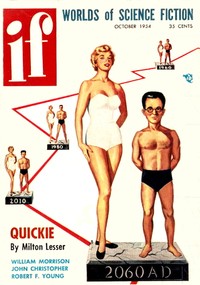
Spatial Delivery — Background and Themes
Edition facts
Randall Garrett's Spatial Delivery opens with a precise spatial marker: "One thousand seventy-five miles above the wrinkled surface of Earth, a woman was in pain." The story immediately establishes a tension between the clinical order of a space station and the unruly biological event of childbirth. Lieutenant Alice Britton's labor is timed to radio windows, not contractions, as the station orbits Earth every two hours. Major Banes, the station's doctor, initially responds with anger—calling her "careless or brainless"—but the narrative shifts from reprimand to problem-solving. The excerpts show a story less concerned with space heroics than with adapting terrestrial protocols to orbital constraints.
Institutional Friction and Personal Agency
The story's early conflict is bureaucratic. Major Banes's outburst—"We're not equipped for obstetrics up here"—highlights the station's lack of preparation. Yet Lieutenant Britton does not panic; she responds with measured calm, running a hand through her brown hair and insisting she'll be fine. The power dynamic is subtle: Banes holds authority, but Britton's composure and her husband's status as a "rocket jockey" complicate his reprimand. Garrett uses dialogue to show how institutional rules bend under practical pressure. Banes's initial refusal to let her return to Earth—citing the danger of eight gravities of acceleration—forces the characters to improvise. The tension is not between humans and space, but between policy and circumstance.
The Station as Makeshift Womb
The resolution hinges on a reinterpretation of the space station itself. Banes explains: "A space station is a kind of incubator itself." The solution—sealing an airtight room, sterilizing it, warming it, and adding extra oxygen—treats the station's existing infrastructure as a life-support system for a newborn. This logic inverts the earlier fear that space is hostile; instead, the station's protective shell becomes an advantage. The baby, James Edward Britton II, is born before Captain Britton even arrives, underscoring how quickly the crew adapts. Garrett avoids melodrama; the birth is reported matter-of-factly, with Banes more concerned about protocol than peril.
Voice and Period Detail
The story's 1954 origin is evident in its language and assumptions. The male characters—Banes, Colonel Gates, Captain Britton—dominate the decision-making, while Lieutenant Britton is described through her physical appearance and emotional restraint. The phrase "rocket jockey" and the casual reference to a supply rocket suggest a near-future where space travel is routine but gendered roles remain Earth-bound. The prose is efficient, with short paragraphs and dialogue that advances the plot without introspection. The opening line's "wrinkled surface of Earth" is one of few descriptive flourishes; otherwise, the style prioritizes action and problem-solving over atmosphere.
Contrasts in Tone and Expectation
Garrett balances humor and tension through tonal shifts. Banes's initial fury gives way to a "grin" and a joke about taking a poke at the captain. The colonel's raised eyebrow and laconic "Excellent, Major!" undercut the drama. The story's premise—a pregnancy on a space station—is treated as both a crisis and a joke, a "historical event" that is also a logistical puzzle. The excerpts do not reveal how the pregnancy occurred (the husband's visit is mentioned but not depicted), leaving a gap that the story may or may not fill. This ambiguity keeps the focus on the immediate problem: delivering a baby in orbit.
Readers should attend to how Garrett uses the space station's physical constraints—orbital timing, radio blackouts, acceleration limits—as plot devices rather than mere setting. The story rewards attention to its small details: the wristwatch, the emergency oxygen tanks, the incubator that proves unnecessary. These elements ground the speculative premise in concrete problem-solving. Spatial Delivery is a compact example of mid-century science fiction that treats a domestic event as an engineering challenge, blending workplace comedy with genuine tension about survival in a closed environment.