The Hermit of Mars — A Reader’s Guide
Edition facts
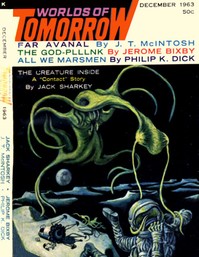
Martin Devere, at 91 the oldest—and for many years the only—human on Mars, lives in a pressurized igloo and spends his days excavating artifacts. The story opens with his quiet routine disrupted by a second rocket landing, much larger than the automatic supply ship he receives every conjunction. Devere's annoyance at the unannounced visit quickly gives way to a deeper tension: the newcomers are not fellow archaeologists but men carrying a bomb they call "Baby," intended for an unspecified target on Earth. The narrative, originally published in Worlds of Tomorrow in 1963, builds its drama through small, deliberate actions—Devere polishing a ceramic fragment while the men discuss burning plans and sending ultimatums.
The Weight of Solitude
The story establishes Devere's isolation not as a plot device but as a lived condition. He has chosen to reject Earth's "latest microfilmed newspapers and magazines, the taped TV shows and concerts," keeping only what he deems necessary. His reports to the Institute are "rubbish anyway," written only to keep them satisfied. When the supply rocket once failed to return, he happily returned the artifacts he had been forced to send. This is a man who has built a life around refusal—of connection, of obligation, of Earth itself. The arrival of the two men, with their urgency and their weapon, forces him to re-engage with a world he has spent decades ignoring.
Objects and Their Meanings
Throughout the excerpts, Devere is repeatedly shown handling artifacts: a fragment of ceramic he cleans until "a complex geometric design was visible, etched in reds and blues." The narrator notes it "might have been equally a decoration or some mechanical diagram." This ambiguity mirrors the story's central conflict—what appears to be a relic of a dead civilization may hold a purpose Devere cannot yet see. The men's plans, too, are treated as objects: tied into a bundle, burned in an oven, stirred into ash. Devere's hands work in "a slow circular motion" as he questions them, his physical labor contrasting with their talk of ultimatums and missiles.
The Bomb as a Narrative Device
The weapon called "Baby" is described only in fragments: it can "out-run anything else that flies," it cannot be fired from Earth by radio because "somebody might try jamming," and it is hidden somewhere in the Martian desert. The bald man's broken ankle—a result of low-gravity miscalculation—delays their departure, leaving Devere alone with the tall man and the bomb. The story uses this delay to let Devere ask pointed questions: "Supposing the United Governments find out where it—the bomb is. They might send a missile to blow it up." The tall man's dismissive answers only heighten the sense that Devere's world—his igloos, his diggings—is collateral damage in a conflict he has no part in.
The excerpts end with the tall man leaving to rescue his injured partner, Devere left holding the polished ceramic. The story's tension lies not in action but in the spaces between words—Devere's silence, the men's evasions, the bomb's unseen presence. Readers should attend to how Bartholomew uses Devere's age and isolation to frame the conflict: not as a thriller but as a meditation on what one person can protect when the rest of the universe refuses to leave him alone.