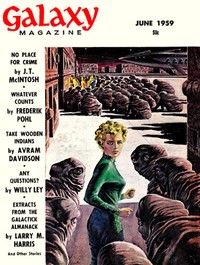
Extracts from the Galactick Almanack: Music Around the Universe — Edition Insights
Edition facts
The catalog subjects for this work—Science fiction, Short stories, Extraterrestrial beings -- Fiction, Musicians -- Fiction—accurately reflect its content, but the execution is far from straightforward. Rather than a conventional narrative, the text presents itself as an excerpt from a galactic almanac, complete with editorial disclaimers about omitted entries and a note on date conversion via "Winstock Benjamin's Least Square Variable Time Scale." This framing device immediately signals that the book is less about music itself and more about the humorous implications of cross-species cultural exchange.
The Almanac as Satirical Frame
The opening pages establish a mock-scholarly tone. The narrator explains that certain entries—such as the "four-dimensional doubly extensive polyphony of Green III"—have been omitted for general readership, and that dates have been standardized to the Terran Calendar. This bureaucratic voice is a running joke, undercutting the supposed authority of the almanac. For instance, the entry on Freem Freem, a child prodigy from Dubhe IV, describes his first concert at age four—but a footnote reveals that a Dubhe IV "year" equals 300 Earth years, meaning Freem was actually 1,200 years old at his debut. The deadpan delivery of this absurdity is the core of the humor.
Cultural Relativism in Music
The excerpts repeatedly highlight how alien biology and social norms shape musical practice. The entry on Calk, a scientist on Lavoris II, illustrates a conflict between scientific and artistic castes. Calk grows an orchestra from seeds, which his beloved Silla—a musician—rejects as inauthentic. The story ends with Calk rolling away "with crackling dignity," a phrase that underscores the physicality of the alien characters. The text also references racial-sex "music" on Shem VI, VII, and IX, which is censored for local audiences, hinting at further cultural divergence. These details show that the catalog subject "Extraterrestrial beings -- Fiction" is not merely a backdrop but the engine of the satire.
Voice and Structure as Evidence
The almanac format allows for a fragmented, encyclopedia-like structure, with each entry standing alone. The voice is consistently formal and explanatory, even when describing absurd scenarios. For example, the entry on Freem Freem notes that "Respected critics refused to believe that Freem was as young as his manager (an octopoid from Fomalhaut) claimed." The parenthetical aside about the manager's species is delivered without irony, mimicking the style of a real reference work. This contrast between tone and content is the primary literary device. The catalog subject "Short stories" is technically accurate, but the pieces are more like vignettes or mock-articles than traditional stories with plot arcs.
Illustrations and Visual Humor
Don Martin's illustrations, mentioned in the metadata, are an integral part of the work. The excerpts do not include the images, but the text references visual elements such as "solidographs" of Freem Freem's performances. The combination of Martin's cartoonish style—known from Mad magazine—with the dry almanac text likely amplifies the satire. Readers should be aware that the visual component may alter the tone significantly, adding a layer of slapstick that the text alone does not convey.
This work rewards attention to its framing devices and the gap between its scholarly pretense and its absurd content. The catalog subjects are accurate, but they undersell the satirical edge. Readers expecting straightforward science fiction about musicians will find instead a playful critique of cultural assumptions, delivered through a meticulously deadpan editorial voice. The brevity of the excerpts means that the full range of the almanac's entries remains unknown, but the pattern is clear: music is a lens for exploring relativity—both temporal and cultural.