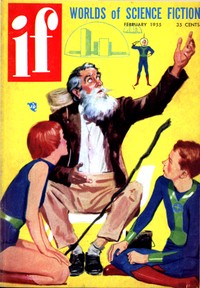

Little Boy — Background and Themes
Edition facts
Jerome Bixby's Little Boy (published under the pseudonym Harry Neal) opens with a precise, animalistic portrait of its young protagonist: Steven drops over a stone wall and flattens to the ground, looking 'like a young wolf.' The setting is a ruined New York City, where Central Park has become a hunting ground and the shattered apartment buildings across the street are described as 'the teeth of a skull's smile.' The story's tension derives not from grand battles but from small, constant calculations—when to move, when to hide, when to fight.
Survival as a Physical Grammar
The excerpts show survival encoded in every gesture. Steven's movements are described with mechanical precision: he kneels motionless for five minutes, scans the street, listens for dogs. The prose mirrors his hypervigilance, shifting between close focus on his body and wide shots of the ruined cityscape. When he encounters two men hidden under leaves, the narrative notes that he had not seen them because they were 'looking the other way.' This detail underscores the story's logic: danger is omnidirectional, and safety is a matter of timing and luck.
Bixby avoids explaining the catastrophe. The world is simply broken, and the characters adapt without commentary. Steven's knife is never described as a weapon—it is an extension of his hand, as natural as breathing. The story's voice is lean, almost reportorial, which amplifies the brutality of its setting.
The Girl and the Unfamiliar Smile
The pivotal encounter with a girl introduces a disruption to Steven's survival code. She does not attack; instead, she shows him 'a strange snarl that wasn't a snarl.' The narrative dwells on this ambiguity: her expression unsettles him because it does not trigger his usual fight response. She puts away her knife and says 'Friends, little boy'—a phrase that Steven struggles to process. The word 'friends' is foreign, almost meaningless in his world.
Their tentative play—tossing stones, scuffling—is described with the same careful attention as the earlier violence. The laughter that follows is 'tight, hesitant sounds,' and it brings tears. Bixby does not sentimentalize this moment; the laughter is almost crying, and the children remain alert to footsteps. The scene suggests that human connection is possible but fragile, and the story does not guarantee its survival.
Catalog Subjects vs. Textual Evidence
The catalog lists 'Science fiction' and 'Apocalyptic fiction' as primary subjects, but the excerpts offer no scientific or technological explanation for the disaster. The apocalypse is simply a given—a backdrop for a character study rather than a plot driver. The 'Boys -- Fiction' tag is accurate but reductive: Steven's age is crucial, but the story is not about childhood innocence. His world has erased that category.
The 'New York (N.Y.) -- Fiction' tag is supported by specific landmarks (Central Park West, 72nd Street, Columbus Circle), but the city functions as a ruin, not a recognizable urban setting. The story's speculative element lies in its social premise: what happens to human behavior when civilization collapses. The excerpts show a world where trust is lethal and laughter is a forgotten reflex. The catalog's 'Social speculation' category fits better than 'Science fiction,' as the story explores behavioral adaptation rather than technology.
Readers should attend to the story's physical details—the weight of a stone, the smell of a body, the sound of a footstep. Bixby builds his world through sensory cues rather than exposition. The ending is not included in these excerpts, but the trajectory suggests that the girl's offer of friendship may be as dangerous as any enemy. The story rewards close reading of its small, precise observations.