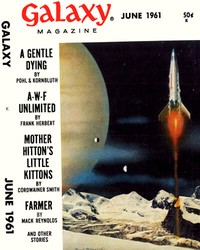
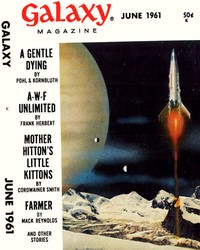
Farmer — Edition Insights
Edition facts
The story opens not with a crisis but with Johnny McCord emptying his pipe and grabbing a sun helmet before stepping into the Saharan sun. His yellow Moroccan babouche slippers, strictly out of uniform, immediately signal a man who values local know-how over headquarters directives. The Sahara Reforestation Commission's top brass issue bulletins from air-conditioned offices in Colomb-Bechar and Timbuktu, while field men like McCord do the real work. This contrast between bureaucratic posturing and on-the-ground pragmatism is established within the first page, as McCord checks an auto-copter, notes flickering red lights, and pours himself a Tuborg beer—defying medical taboos about iced drinks in this climate. The opening paragraph efficiently sets up a protagonist who trusts his own judgment over institutional rules.
The Sabotage Premise and Political Pressures
The title Farmer and the catalog subject of sabotage suggest that the reforestation project faces deliberate opposition. Early dialogue reveals multiple fronts of conflict: domestic political opposition over expenditures, Soviet accusations of Western imperialism, and Southeast Asian claims that the land should be used for farmland instead of forest. Johnny McCord's weary response—'Let's face it. They're right'—when Mellor denies Western ambitions shows the story's willingness to acknowledge uncomfortable truths. The arrival of journalist Hélène Desage, whom McCord must 'handle with loving care,' introduces a wildcard. The excerpts show her aggressive walk and his groan, hinting at friction. Readers should watch how these external pressures manifest in the sabotage plot, and whether McCord's field expertise will be enough against forces that operate beyond his immediate view.
Voice and Dialogue as Characterization
Reynolds uses dialogue to reveal character quickly. When Derek Mason enters, Johnny greets him with a 'horrible caricature of a New England accent' and a joke about a cyclone. The exchange—'Did the cyclone hurt your barn any?' / 'Don't know, Hiram, we ain't found it yet'—establishes a camaraderie built on shared absurdity. Later, Pierre hands Johnny an already-opened beer and comments on Hélène's approach: 'I am afraid Mademoiselle Desage is unhappy about something.' The banter is dry, understated, and laced with sarcasm. Even Mellor's pompous speech—'Things are on the touchy side right now. Very touchy'—is undercut by Johnny's internal eye-rolling. This voice suggests a protagonist who copes with bureaucratic nonsense and danger alike through humor. The excerpts do not reveal whether this tone persists under threat, but it sets expectations for a narrative that balances tension with wry observation.
Setting as a Character: The Sahara Project
The Sahara is not just a backdrop but an active element in the story's logic. The perpetual sand hazard to equipment, the need for sun helmets, the 'damned sand' that throws red lights on auto-copters—these details ground the speculative premise in tangible difficulty. The reforestation project aims to change the climate by foresting the area first, then opening land for farming. Johnny explains that the Southeast Asia Bloc's demand for farmland is 'putting the cart before the horse.' The setting also dictates social rules: the Commission's medics forbid iced beer, but McCord ignores them. The Arab ground crew, the yellow babouche slippers, and the reference to centuries of footwear know-how show a respect for local adaptation. Readers should note how the environment shapes both the plot's obstacles and the characters' daily routines, making the sabotage threat feel like an intrusion on a already precarious operation.
What the Excerpts Leave Unresolved
The provided text cuts off before the sabotage plot fully develops. We know someone 'didn't like trees' and is willing to murder, but the identity and motive remain unclear. The excerpts show no actual violence, only hints of tension: the flickering red lights on auto-copter 4, Mellor's vague references to 'pressures on the highest levels,' and the arrival of a journalist who might uncover something. The story's short length—13,710 words—suggests a tight narrative where these threads will converge quickly. Readers should pay attention to minor details: the card-punch, sorter, and collator that McCord uses; the mention of Reuben as a mechanic; the goat butchering that Derek and Mohammed oversee. These may become clues or red herrings. The ending is not revealed in the excerpts, so the resolution of the sabotage and the fate of the Sahara Project remain open questions.
Approach Farmer as a fast-moving story that trusts its readers to pick up on political subtext and technical details without exposition. The opening establishes a protagonist who works around bureaucracy, not within it, and the excerpts suggest that the sabotage plot will test both his competence and his alliances. The Sahara setting is not exotic decoration but a functional element that drives conflict. Because the excerpts are incomplete, focus on how Reynolds builds suspense through small anomalies—a flickering light, a tense phone call, an aggressive visitor—rather than through overt action. The novella's brevity rewards attention to early details that may pay off later.