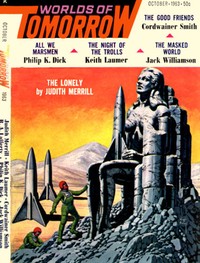

Pretty Quadroon — Reading Notes
Edition facts
Charles Fontenay's Pretty Quadroon (1957) opens with General Beauregard Courtney observing troop movements near Tullahoma, Tennessee, in a Second War for Southern Independence. The narrative immediately establishes a distinctive voice: Beauregard addresses a Black courier as "you damn black coon" without rancor, and the courier's dialect is rendered with "suh" and a flash of teeth. This casual racism, set against a backdrop of tanks and tactical air support, signals the story's central tension—a romance across the color line in a society that enforces racial hierarchy.
Diction and the Social Order
Fontenay's word choices reveal the social assumptions of his alternate Confederacy. Beauregard's epithet "black coon" is delivered without malice, suggesting ingrained prejudice rather than personal animus. The courier's response—"Miss Piquette told me to bring you the message, suh"—uses the honorific "suh" and refers to a white woman by title, reinforcing racial deference. Later, Adjaha explains that Beauregard cannot love Piquette in a peaceful South because "a woman of Negro blood cannot be your paramour unless she is socially recognized as an inferior." The term "paramour" itself carries a judgment of illegitimacy. These lexical choices embed the period's racial attitudes into the fabric of the dialogue.
Alternate History Through Military Detail
The opening paragraphs ground the alternate history in concrete military specifics: the 184th moving into trenches at Camp Forrest, a pincer movement from Pelham and Lynchburg, and the goal of enveloping Tullahoma. Fontenay contrasts this "soldier's warfare" of tanks and infantry with "cold, calculated, long-range bombardment by guided missiles." The narrator notes that no nuclear weapons have been used, only atomic artillery, and that Soviet Russia watches "with glee." These details create a plausible divergence point—the Second War for Southern Independence—without over-explaining. The reader is dropped into a recognizable but altered Civil War, where the South fights with modern technology but retains its antebellum social structure.
Time as a Narrative Device
Adjaha's explanation of time manipulation introduces the story's central conceit: "the future can change the present." He describes utilizing "ancient knowledge" involving "dimensions beyond time" to alter decisions at "a dozen points in the past." This allows Fontenay to explore multiple timelines—one where Beauregard is governor in a peaceful South, another where he is a general in a losing war. The mechanism is vague but functional: Piquette's presence or absence determines whether the South is at war or peace. Adjaha's phrase "fan-shaped destiny" suggests branching paths, though the excerpts do not reveal how many iterations occur. The device serves less as hard SF and more as a lever to examine how personal relationships intersect with historical forces.
Piquette as Catalyst and Symbol
Piquette is described as a "pretty quadroon," a term that specifies her racial mixture (one-quarter Black). She is the emotional center of the plot: Beauregard's love for her triggers the war timeline, and Adjaha's goal is to prevent their meeting. Her role is largely passive in the excerpts—she delivers messages, nurses Beauregard, and defers to his decision about calling medics. Yet she is also the key to Adjaha's scheme. The story uses her as a symbol of forbidden desire, but the excerpts do not reveal her interiority. Fontenay's choice to make her a "quadroon" rather than a Black woman reflects the era's racial categories and the story's focus on the social taboo of miscegenation rather than on Piquette's own experience.
Readers should attend to how Fontenay balances the alternate-history military action with the romance plot. The excerpts suggest that the time-manipulation framework allows for multiple revisions of history, but the story's emotional weight rests on Beauregard's attachment to Piquette. The illustrations by Virgil Finlay, known for his detailed line work, likely complement the period setting. This novella rewards attention to its linguistic choices and its handling of race as a driver of plot rather than a background detail.