The Big Leap — Background and Themes
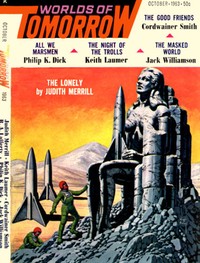
Edition facts
The story opens inside Cantrell's rocket, where the narrator immediately establishes a tension between the astronaut's technical competence and his visceral dread. He presses studs with "swift precision," yet the emptiness outside triggers a cold shame. Fritch uses the phrase "whistling past silent graveyards" to capture the irrational fear that persists despite rational knowledge—a fear the psychologists cannot erase. The prose stays close to Cantrell's consciousness, alternating between his practiced actions and his unsettling thoughts about "the bogey man that waited lurking in the velvet depths."
A Controlled Opening and a Sudden Break
The first excerpt builds Cantrell's internal conflict methodically. He recalls the psychiatrists' probing for "a mental return to the womb" and laughs at his own "animal allergy," which is dismissed as insignificant. The narrative voice is measured, clinical even, as it describes the ship's maneuvers and the gyro-chair's compensation. Then, without transition, the tone fractures. The moon appears on the screens, described as "chalky and pockmarked, like the skin of a diseased animal." A "great baleful eye" stares from a crater. Cantrell screams. The shift is abrupt and unexplained—the reader is left with the same jolt Cantrell experiences, unsure whether this is hallucination or revelation.
Ground Crew Debate: Two Explanations
The second excerpt moves to a conversation between Colonel Evans and Captain Jarvis, a psychiatrist. Jarvis offers two competing interpretations. First, Cantrell's animal phobia triggered a hallucination—a neat psychological explanation. But Jarvis immediately undermines it by proposing a second: that Earth itself is a "space-animal," and space travel restores a sanity lost under "mass auto-hypnosis." He compares humans to fleas unaware of the dog they live on. Evans dismisses this as crazy, yet the narrative lingers on Jarvis's logic. The dialogue is structured as a debate, with Jarvis calmly advancing the more disturbing possibility while Evans sputters. The reader is left to choose which explanation to trust—or to accept that neither is complete.
Recurring Imagery and the Unreliable Witness
Fritch seeds the text with images that blur the boundary between metaphor and fact. The moon is first a "pale satellite" emerging like a child following its mother, then a diseased animal with glowing veins. Cantrell's fear of animals is established early as an "insignificant" allergy, yet it becomes the lens through which he perceives the cosmos. The story's title, The Big Leap, refers both to the physical journey and the interpretive leap required of the reader: do we accept the psychiatrist's rationalization, or entertain the possibility that the universe is alive and hostile? The excerpts provide no resolution, only a mounting unease.
Structure: Shifting Perspectives and Unanswered Questions
The excerpts move from Cantrell's first-person-limited viewpoint to a third-person dialogue between Evans and Jarvis. This structural shift mirrors the thematic shift from personal terror to philosophical doubt. Jarvis's final line—"I'm going to volunteer for the next flight"—suggests a cycle: each new pilot will face the same ambiguity. The story does not confirm whether Cantrell's vision was real; instead, it leaves the reader with Evans's trembling thought: "Earth an animal—the idea was preposterous. But the thought hammered at him." The narrative refuses to settle on a single explanation, making the reader complicit in the uncertainty.
Readers should pay close attention to how Fritch uses Cantrell's allergy as both a plausible cause and a potential red herring. The story rewards those who track the shifting reliability of each character's perspective. Because the excerpts end before any resolution, the full text likely deepens the ambiguity rather than resolving it. Approach the story as a puzzle in which the evidence is deliberately incomplete—and the final answer may depend on which character's worldview you choose to trust.