The Contact Point — A Closer Reading
Edition facts
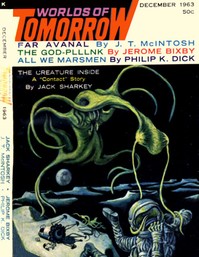
Jack Sharkey's "The Contact Point" opens with Lieutenant Lloyd creeping through a ruined Martian city, his breath rasping behind his faceplate. The prose is taut and sensory: loose gravel betrays him, the alien spins with a crystal tube, and the first exchange—"Ookl okkl?"—is met with a grin. The story's language oscillates between Lloyd's colloquial relief ("Boy, am I glad you Martians are friendly!") and the creeping unease of miscommunication. The aliens are not Martians but Venusians, a fact Lloyd realizes only after a night of mounting dread. The narrative voice, initially focused on physical detail and halting dialogue, shifts to interior monologue as Lloyd's intuition wars with his duty.
Voice and the Failure of Language
The story's central tension lies in language. Lloyd's first attempts at communication are comically literal: he points, holds up fingers, and shouts. The alien Ulkay responds with careful repetition—"Ulkay," "Blet," "Ulkay Blet"—and an "almost Earthlike shrug." Sharkey uses dialogue to highlight the gap between intent and understanding. Lloyd's internal voice grows more anxious as the night progresses: "So what's eating me? A hunch? Intuition? Or just alien-planet nerves?" The narrative never translates Ulkay's speech, preserving the alien's otherness. When Lloyd finally grasps the truth—"They are fine—but, Kroner, they're not the right aliens!"—the revelation is delivered in a fractured, breathless sentence that mirrors his panic.
Pacing and the Shift from Action to Dread
The story's pacing mirrors Lloyd's psychological arc. The opening scene is brisk and cinematic: a stealth approach, a weapon drawn, a sudden grin. Action verbs dominate—"crept," "spun," "froze," "reholstered." But after the initial contact, the narrative slows. The middle section is almost entirely interior, with Lloyd lying awake cataloging his men's breathing: "Kroner grunted in his sleep and rolled over. Tandy's helmet emitted gentle snoring noises." This quiet observation builds dread through mundane detail. The pace accelerates again only in the final paragraphs, when Lloyd shouts "Mayday!" and the Venusians find their scabbards empty. The climax is abrupt and violent, ending with "half-molten air compressors" and a "bilingual chorus of agony."
Setting and the Unreliability of First Impressions
The Martian setting is sketched in broad strokes—"ruins of the strange red Martian city," "rubble-strewn street," "thin Martian atmosphere"—but it functions as a stage for misdirection. Lloyd assumes the first alien he meets is a Martian; the narrative never corrects him until the final twist. The ruins themselves are never described in detail; they exist only as a backdrop for the encounter. Sharkey uses the setting to reinforce the theme of mistaken identity: the characters sleep in a chamber that feels safe, but the "glaring overhead lights" that reveal the true Martians transform the space into a trap. The story's brevity (6,460 words) means every setting detail serves the plot, from the "empty scabbard" to the "funny-looking little nozzle" that becomes a weapon.
Readers should attend to the story's deliberate misdirection: the title "The Contact Point" refers not to the first meeting but to the moment of violent revelation. Sharkey's prose rewards attention to small details—the extra finger Lloyd holds up, the Venusians' empty scabbards—that foreshadow the twist. The story is best read in one sitting, allowing the shift from light comedy to horror to land with full force.