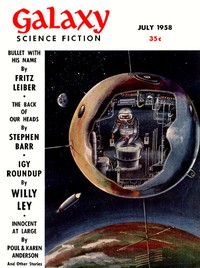

A Pail of Air — Edition Insights
Edition facts
Fritz Leiber's 'A Pail of Air' begins with a boy sent to scoop frozen air from the rooftop—a mundane chore in a world where Earth has been torn from the Sun. The first-person narration immediately establishes a voice that is both childlike and hardened by catastrophe: 'Pa had sent me out to get an extra pail of air.' The boy's initial shock at seeing what he thinks is a young lady's face in a dark window gives way to the realization that it is only a light, 'moving stealthily from window to window.' This moment of misperception sets the tone for a story that constantly balances the familiar against the terrifying, as the narrator's matter-of-fact descriptions of frozen air, homemade spacesuits, and the 'Nest' of blankets make the impossible seem routine.
The Voice of a Survivor
The narrator's voice is the story's engine. He speaks in short, breathless sentences that convey both urgency and a child's limited understanding: 'I tell you, the thought of it gave me the creeps.' His observations are concrete—the feel of cold leaking through his fingers, the ticking of clocks in the Nest—and his comparisons draw from a world he knows only through old magazines and his father's stories. When he sees the light, he imagines 'one of the cruel little stars' coming down to torment the Earth. This blend of innocence and dread is sustained throughout the excerpts, making the reader experience the horror through a lens that is not yet fully cynical.
The Nest as a Stage for Philosophy
The Nest, a low chamber of blankets and rugs, is both a physical refuge and a stage for the father's existential speeches. In the middle excerpt, Pa delivers a monologue on why life is worth living even for the last humans: 'Life's always been a business of working hard and fighting the cold.' He argues that the texture of life—'like some rich cloth or fur, or the petals of flowers'—makes the struggle worthwhile. This speech is interrupted by the sound of shuffling steps and a bulging blanket, creating a tension between abstract hope and immediate threat. The father's words are not just comfort; they are a survival strategy, a deliberate act of will against despair.
The Arrival of the Outsiders
The climax of the excerpts introduces a young woman in a suit and helmet, accompanied by two men. The narrator's initial terror—'my heart couldn't have been stopped for more than four or five beats'—dissolves when he realizes they are not frozen ghosts but survivors from Los Alamos, powered by atomic energy. Their reaction mirrors the reader's: one man insists the family's air supply is 'impossible' without hermetic sealing, while the young woman cries, calling them 'saints.' This reversal—from threat to salvation—is handled with restraint, as the narrator's wonder at their electric lights and rocket ships is understated. The encounter redefines the story's stakes, suggesting that hope may come from unexpected technology.
Routine as Resistance
Throughout the excerpts, the family's daily rituals—fetching air, maintaining the Nest, reading books—are portrayed as acts of defiance against cosmic indifference. The father's philosophy is not abstract; it is embedded in the boy's chores. The opening line, 'Pa had sent me out to get an extra pail of air,' establishes that survival depends on repetitive, unglamorous work. Even the boy's fear of the light is tempered by his need to recover the dropped pail. This emphasis on routine gives the story a grounded, almost domestic texture, even as it deals with the end of the world. The arrival of the Los Alamos group does not erase this; rather, it validates the family's stubborn persistence.
Leiber's story rewards attention to its small details: the aluminum foil on blankets, the boy's frosty helmet, the way sound returns as he enters the Nest. The excerpts do not reveal the full resolution, but they establish a pattern of tension and relief that suggests hope is earned through endurance. Readers should note how the father's speeches are not separate from the action but intertwined with it—his words are a response to the shuffling steps outside. The story's power lies in its refusal to choose between despair and optimism, instead showing how both can coexist in the same moment.