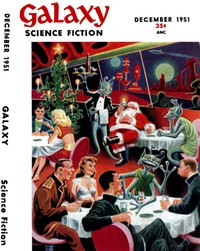

Innocent at Large — Reading Companion
Edition facts
The story opens not with the Martian but with Peri, a professional seductress, adjusting her appearance before a visiphone call. The narrative voice immediately establishes a cynical, fast-paced tone: Peri's robe is described as a 'wisp of translucence' that cost a corporate president 'several thousand dollars,' and her movements are calculated for maximum effect. The dialogue crackles with slang and hyperbole—'Holy Success,' 'strictly from gone'—as con man Gus Doran pitches a mark: a Martian with a hundred million dollars in expense money and 'about as much backbone as a piece of steak alga.' The prose favors short, punchy sentences and vivid physical details, from Doran's 'prawnlike eyes' to Peri's 'silver-blue gaze.'
A Voice of Calculated Excess
The Andersons' prose leans into exaggeration as a stylistic weapon. Characters speak in superlatives and metaphors drawn from commerce and technology: Doran whispers 'in awe' that Peri's appearance might overload the wires, and later describes the Martian as 'strictly from gone.' The narrative voice matches this energy, describing Peri's apartment as 'ivory and ebony' and her dress as 'poured on.' Physical descriptions are deliberately over-the-top—Peri's 'peaches-and-cream countenance' turns to something left 'overnight on Pluto.' This hyperbolic register signals that the story operates in a mode of comic cynicism, where every character is performing a role. The dialogue, especially Doran's rapid-fire sales pitch, drives the pace, with interruptions and exclamations mimicking the rhythm of a con in action.
Shifting Perspectives and Unreliable Information
The excerpts reveal a narrative that moves between characters' viewpoints, each offering a partial and self-serving version of events. The opening scene is focalized through Peri, then shifts to Doran's scheming perspective, and later to Matheny, the Martian, who reveals a stunning counter-con: the 'Old Martian' ruins and relics are fakes, manufactured by his own people. This revelation is delivered in a matter-of-fact tone—'We erected the ruins fifty years ago'—that undercuts the reader's assumptions. The story thus layers cons within cons: Doran plans to fleece the Martian, but the Martian's people have been fleecing Earth for decades. The narrative voice remains neutral, letting the characters' conflicting schemes create a sense of escalating uncertainty. The reader is left to wonder who is truly the 'innocent' of the title.
Pacing Through Dialogue and Physical Comedy
The story's pace is largely driven by rapid-fire dialogue and physical gags. Doran's speech is peppered with interjections—'Holy Success,' 'I will be clopped!'—that keep the energy high. The Martian, Matheny, is characterized by stammering and awkwardness: 'I, I, I,' he stammers, spilling his drink. Peri's theatrical movements—extending a 'flawless leg' from a slit skirt—are described with a winking awareness of their absurdity. The prose often cuts between action and reaction in quick succession, as when Doran 'removed the helmet and stood up' after a tense exchange. These shifts in physical posture mirror the story's tonal shifts from comedy to revelation. The excerpts suggest a narrative that alternates between scenes of verbal sparring and moments of quiet confession, maintaining a brisk rhythm throughout.
Readers should attend to the story's title, which may be ironic: the 'innocent' could be the Martian, the Earth con artists, or neither. The excerpts offer only the opening setup and a mid-story revelation; the resolution is not included. Pay attention to how the narrative voice handles the multiple layers of deception—whether it maintains a consistent tone or shifts to accommodate the Martian's perspective. The story's brevity (under 11,000 words) suggests a tight plot, likely building to a final twist that recontextualizes the earlier scenes.