Freeway — Context and Discussion
Edition facts
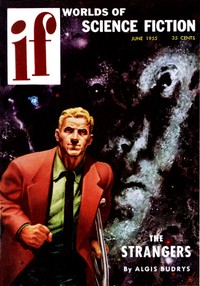
Bryce Walton's Freeway opens with a sentence that functions as both premise and verdict: the Morrisons are not stripped of freedom but sentenced to the highways for life, driving without destination. The story, first published in Worlds of If Science Fiction in 1955, sustains a taut, claustrophobic atmosphere through its narrative voice and deliberate shifts in pace. Walton alternates between Stan Morrison's interior dread—his wife's hysteria, the "bitter veil of resignation" on her face—and bursts of physical action, such as the sudden stop at an Indian trader's shack. The prose itself mimics the rhythm of the road: long, hypnotic passages of description give way to sharp, fragmented dialogue and urgent verbs. This editorial note examines how Walton uses language, voice, and tempo to embody the story's central tension between enforced motion and the longing for stillness.
A Voice Trapped in Motion
The narrative voice in Freeway is tightly bound to Stan Morrison's perspective, and its syntax reflects his entrapment. Walton favors long, rolling sentences that mimic the endless highway: "He stared down the super ten-lane Freeway, down the glassy river, plunging straight across the early desert morning—into nowhere." The repetition of directional phrases and the use of em-dashes create a sense of forward momentum without arrival. Stan's thoughts are often rendered as direct interior monologue, as when he reflects that he and Anna are "like mobile bugs caught in a gigantic concrete net." This simile, drawn from the natural world, underscores their dehumanization. Yet the voice also registers moments of sharp, sensory detail—"the flat heavy violence to the blast of morning sun on his face"—that break the monotony and hint at a world beyond the car. Walton's control of voice ensures that the reader experiences the same oscillation between numbness and acute awareness that Stan feels.
Pacing as a Mirror of Constraint
The story's pacing is carefully calibrated to reflect the Morrisons' predicament. Early passages are slow, almost static, dwelling on Stan's observations of his wife's face in the rear-view mirror and the endless landscape. The prose lingers on the "bluish haze of the desert's tranquil breath" and the jackrabbit that freezes on the Freeway's fringe—a moment of stillness that contrasts with the relentless motion of the car. As the plot progresses, the tempo accelerates. When the old Indian helps them disable the car's remote control and radar, the sentences become shorter and more urgent: "Stan finally nodded and took Anna's arm and they started toward the Special." The escape sequence is marked by rapid, imperative dialogue—"Turn, Stan. Turn!"—and a flurry of action verbs: "roared off," "smashed through," "twisting tortuously." This shift from languid description to breathless action mirrors the characters' transition from passive suffering to active flight.
Recurring Details and Their Weight
Walton builds the story's world through a handful of recurring details that accumulate meaning. The "super ten-lane Freeway" is described as a "glassy river" and later as a "flood water" from which the old man offers to help them "sit on the bank." This water imagery recurs, linking the highway to a natural force that is both overwhelming and purifying. The car itself is repeatedly called a "cage" or a "suffocating cage," a metaphor that reinforces the paradox of freedom through movement. Anna's characterization hinges on a single repeated trait: she is "highly emotional, vital, active, a fighter"—a description that makes her later passivity and hysteria more poignant. The old Indian and Doctor Bergmann appear as figures of rescue, but their identities remain deliberately vague; Bergmann is recognized only by his weight loss and a rifle. These recurring elements—the highway as water, the car as cage, the helpers as nameless—create a cohesive symbolic texture without overexplaining.
Readers approaching Freeway should attend to how Walton manipulates sentence rhythm and paragraph length to evoke the psychological toll of perpetual motion. The story's brevity—just over 8,000 words—belies its layered use of repetition and variation. Note how the opening's declarative flatness gives way to the fragmented, breathless prose of the escape, and how the final image of the Special driving driverless up a mountain road leaves the resolution ambiguous. The excerpts do not reveal the story's ending, but the trajectory of its language suggests that true freedom may lie not in stopping, but in choosing one's direction.