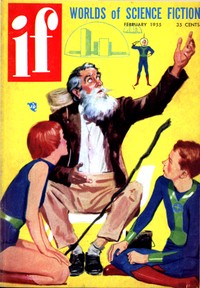

Ignatz — Text and Context
Edition facts
Ron Goulart's Ignatz opens with Glenn Wheelan stepping off a night beach and immediately voicing his hatred of cats—a visceral reaction that frames the story's central conflict. The setting is San Miguel, a California town that has become a haven for a cult led by Balderstone, who promises transformation through 'applied lycanthropy.' The catalog subjects list 'shapeshifting' and 'cats,' but the excerpts show that the story is less about literal metamorphosis than about the social dynamics of a community that embraces it. Wheelan's disgust is personal and physical, not philosophical; he recalls a childhood cat that made him sneeze. The cult's appeal is presented as a form of escapism, not a genuine solution to problems.
The Cult of Applied Lycanthropy
Balderstone's method is described in the excerpts as a beam that triggers transformation when participants swallow a capsule. The scene at the rodeo grounds is the story's set piece: ties and hats fly, clothes tangle, and people become cats. Goulart's prose is brisk and visual, focusing on the chaos rather than the mechanics. The cult's rhetoric is deliberately shallow: 'If you can't change the world, you can change yourself. At least for awhile.' This is not a deep exploration of identity but a satire of self-help movements. The catalog subject 'shapeshifting' is accurate, but the excerpts suggest the transformation is temporary and presented as a gimmick, not a profound change. Wheelan's reaction—horror and flight—underscores his role as the skeptic in a town that has collectively bought in.
Wheelan's Campaign of Annoyance
After witnessing the transformation, Wheelan does not investigate or reason; he acts. He sets fire to Balderstone's bungalow and drops leaflets from an airplane. The excerpts show his actions are impulsive and destructive, not heroic. His aunt stops cooking for him; he moves to a run-down motel. The story's tone is wry and detached, with dialogue that feels naturalistic. Karen, his girlfriend, tries to calm him, but he is driven by a 'crawly feeling.' The catalog subject 'man-woman relationships' is present in their exchanges, but the relationship is secondary to Wheelan's obsession. The excerpts do not reveal whether his campaign has any effect, only that he persists. This section of the story emphasizes the futility of his one-man war against a popular movement.
Setting and Social Satire
San Miguel is described as 'brighter and cleaner' than before, with a theater showing foreign movies and three laundromats. The town's transformation is tied to the cult's influence, but Goulart does not belabor the point. The catalog subject 'California' is relevant only as a backdrop for a specific kind of suburban absurdity. The story was published in 1960 in Worlds of If, and its concerns—conformity, escapism, and the commercialization of fringe beliefs—fit the era's satirical science fiction. The excerpts do not show the story's ending, so it is unclear whether Wheelan succeeds or fails. What is clear is that Goulart uses the cat-transformation as a metaphor for a community's willingness to abandon reason for comfort. The narrative voice is lean, avoiding exposition in favor of action and dialogue.
Ignatz is a short, fast-moving story that rewards attention to its dialogue and physical details. Readers should note how Goulart builds the town's atmosphere through small observations—the painted slums, the bonfire, the 'giant sunlamp'—rather than through lengthy description. The story's title, a reference to a comic-strip cat, hints at its playful yet pointed tone. Approach it as a snapshot of a particular moment in science fiction, when the genre was turning its lens on American suburban life.