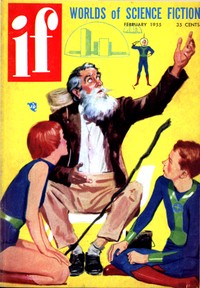

The Good Work — Inside the Classic
Edition facts
Theodore L. Thomas's 1959 story opens with a striking image: Jeremiah Winthrop, a man whose 'traditions sprang from the rocky New England soil,' rides a spiral escalator through a city of 350 billion people. The narrative immediately establishes a tension between the protagonist's inherited dignity and the crushing density of his environment. Thomas builds the world through precise, recurring details—the thumbhole door, the re-scheduled roof visits, the 'Standard Fare' meals—that ground the speculative premise in tangible, everyday frustrations.
The story's structure mirrors Winthrop's daily commute: a repetitive, upward spiral that offers only temporary relief. The excerpts show a careful alternation between cramped interiors (the two-part cubicle, the crawl spaces) and brief, longed-for glimpses of the roof. This movement between confinement and aspiration becomes the story's central rhythm.
The Spiral as Structure and Metaphor
The spiral escalator is more than a setting detail; it organizes the story's movement. Winthrop rides it repeatedly, each time passing floors where others 'elbow his way out.' The escalator is a 'river of people,' a vertical current that carries characters but never lets them escape the crowd. Thomas uses this image to create a sense of endless, circular motion—the building itself becomes a kind of termite mound, with inhabitants swarming in predictable patterns.
The spiral also echoes the story's plot structure. Winthrop's job, tightening nuts on a cycle that repeats every eight years, is itself a spiral: it returns to the same points but at a different time. The narrative follows this loop, moving from home to work and back, with each cycle bringing small changes (a promotion, a new meal plan) but no fundamental escape. This structural repetition reinforces the theme of constrained agency in a world where even roof access is rationed.
Cramped Spaces and the Body
Thomas pays close attention to physical sensation in confined spaces. Winthrop must 'wriggle through confined places' to reach the nuts, and his arm grows sore from the work. Yet the story contrasts this bodily strain with the relief it brings: 'good to feel the sweat start from his brow from hard work instead of from the press of people.' The body becomes a site of both oppression and dignity.
The Winthrop home is described as a 'two-part cubicle,' and the corridors are crowded enough that Winthrop cannot always 'get off a belt at the proper landing.' These details accumulate to create a world where personal space is nearly nonexistent. The only moments of physical ease come in the crawl spaces—paradoxically, the most confined areas—where Winthrop works alone. Thomas uses this irony to suggest that meaningful labor, however cramped, offers a kind of freedom.
The Minister and the Job: Ambiguity in Authority
The job interview with the minister is a masterclass in withheld information. The minister warns Winthrop not to talk about his work, citing the need to prevent jealousy. But the narrative hints at something more: the minister's 'ephemeral expression of sadness' appears twice, and the crew chief mentions that there are 'more men keeping records than there were doing the actual tightening work.'
These details create an undercurrent of unease. The job seems legitimate—the building must be maintained—but the secrecy and the oversized clerical staff suggest a system designed to keep people busy rather than productive. Thomas never resolves this ambiguity in the excerpts, leaving the reader to wonder whether Winthrop's pride is earned or manipulated. The story's satire operates through this uncertainty: the 'good work' may be genuine, or it may be another layer of the bureaucratic machine.
Domestic Interiors and the Promise of the Roof
The Winthrop household scenes provide a counterpoint to the public crush. Inside the cubicle, there is 'much laughter' and 'reading and playing games.' The family's life revolves around small rituals: the thumbhole door, the boy's question about the roof, the planning of meals. These domestic details humanize the story and make the external pressures tangible.
The roof functions as an unattainable goal—a place of 'air and light and sun' that is always a month away. Winthrop's wife Ann reports that 'eighteen hundred babies born in the building this week' have pushed back their turn. The roof is never described directly in the excerpts; it exists only as a promise deferred. This absence makes it a powerful symbol of the good life that overpopulation has rendered inaccessible. The story's emotional weight comes from the gap between the family's small joys and the vast, indifferent system that controls their access to the sky.
Thomas's story rewards attention to its spatial logic: the vertical movement of the escalator, the horizontal crawl of the corridors, the nested interiors of cubicle and crawl space. Readers may notice how the narrative itself moves between these zones, creating a rhythm of compression and release. The excerpts leave key questions open—the nature of the 'good work,' the fate of the family—but the story's power lies in its precise, unadorned rendering of a world where dignity must be carved out of sheer density.